Centralized operations
One navigation model, one permissions model, one support path for your staff.
Victory Team Consultation
Victory Team Consultation unifies intake, damage review, translation, workflow, signing, tasks, and reminders so your firm stops paying the tax of disconnected SaaS sprawl.
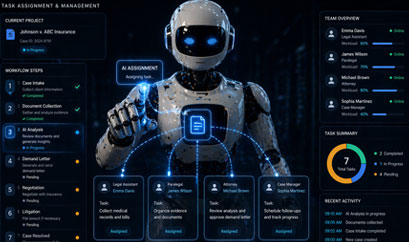
Most “platform” pitches still leave you with seven invoices, five SSO integrations, and three places where a client’s phone number can disagree. Victory Team Consultation is architected as a single AI-powered business system for legal, accident, intake, workflow, communication, document automation, appointments, and client service. Modules share identity, permissions, audit trails, and event vocabulary so automation does not snap when you cross team boundaries.
That unity changes economics. You stop rebuilding the same connectors every time a vendor updates an API. You stop training staff on parallel UIs that cannot agree on status definitions. You stop apologizing to clients who already uploaded a document but to the “wrong” portal.
The suite is modular on purpose: adopt image intake first, add workflow automation when queues stabilize, layer translation when multilingual demand grows. Progressivity reduces risk while preserving the end-state vision—a coherent operating model instead of a pile of best-in-class point solutions duct-taped together.
Connected means a signature event can unlock a document request, which can spawn a task, which can schedule a reminder, which can open a translated meeting room—all referencing the same matter ID and permission graph. It means analytics can answer cross-module questions like “how long from intake photo upload to first client call?” without a data warehouse science project.
AI assists extraction, triage, routing, and drafting—but humans retain authority on privileged and coverage-sensitive decisions. Traditional automation handles the boring reliability work: reminders, escalations, duplicate detection, and SLA clocks.
When modules share a security core, you reduce the surface area where policies diverge. Retention, export controls, and break-glass procedures apply uniformly whether the artifact is a photo, a transcript, or a signed release.
Consolidation lowers total cost of ownership: fewer vendor negotiations, fewer security reviews, fewer training cycles. It also improves throughput metrics that partners actually care about—cycle time, margin per matter, and client NPS.
These outcomes depend on integration—not on any single feature in isolation.
One navigation model, one permissions model, one support path for your staff.
Cross-module reporting reflects reality because events are not trapped in siloed logs.
Add offices, languages, and matter types without multiplying disconnected systems.
Clients interact with a coherent portal instead of a scavenger hunt of links.
Regional firms expanding intake marketing without proportional hiring.
Insurance programs harmonizing vendor ecosystems after mergers.
Legaltech-forward practices pitching clients on differentiated service delivery.
Big-bang migrations are optional; phased adoption is the norm.
Quantify cycle times, tool counts, and failure modes you want the platform to absorb first.
Stand up intake and tasks before advanced automation; add translation when multilingual volume justifies it.
Define KPIs upfront—completion rates, SLA hit rate, revenue per coordinator—so value is provable.
Accident and legal-service workflows do not fail in neat functional boxes. They fail at seams. Building AI tools from start to finish is our commitment that those seams are our problem to solve—not yours to duct-tape.
Straight answers about how this module fits real legal, insurance, and client-service operations.
No. Licensing and configuration can start with a subset of modules while preserving unified identity and permissions.
Deployment options and retention controls are designed for enterprise conversations; your security team sets policy while VTCCO enforces it consistently.
Yes. APIs and event hooks allow bi-directional sync where you still need legacy systems of record during migration.
Role-based learning paths cover intake coordinators, attorneys, and vendor partners with progressive depth.
Versioned workflow definitions and staged rollouts reduce disruption; critical paths can pin to tested versions until you choose to migrate.
Continue exploring modules that pair naturally with this capability.
Walk through how modules compound: intake, triage, collaboration, execution, and measurement in one architecture.