Faster comprehension
Clients follow nuance in real time instead of waiting for post-call written summaries that may miss tone.
Victory Team Consultation
Run multilingual consultations with real-time captions and translated audio so attorneys, clinicians, and service staff stay understood—without bolting on a separate interpreting product.
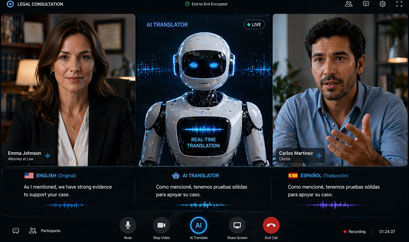
Language mismatch is not a niche edge case—it is a daily reality for firms serving diverse communities and for national programs coordinating with regional providers. The Live Video Meeting Translator embeds translation into the same room where you already discuss treatment plans, liability theories, or repair authorizations. Participants hear or read meaning in their preferred language while the underlying transcript stays anchored to the matter record.
That matters because stitched solutions leak context. When translation lives in a separate consumer app, you lose version control, privilege posture, and the ability to attach outcomes to tasks. Native integration preserves confidentiality expectations while still giving clients the dignity of following complex discussions without guessing.
The experience is tuned for accessibility as well: captions help hearing-impaired participants and noisy mobile environments, while translated audio supports users who process spoken language faster than reading.
Some matters require simultaneous interpretation; others only need post-call summaries. The module supports live captioning, translated speech synthesis, and transcript export so you can choose the intensity that matches risk and budget.
Rooms can carry matter metadata—case numbers, upcoming deadlines, outstanding tasks—so conversations stay grounded instead of drifting into unsecured anecdotes.
Scheduling becomes easier when you are not hunting for a specific interpreter for every 15-minute status call. Staff can rotate through standardized agendas while the translation layer handles comprehension. That predictability improves utilization of senior attorneys and clinicians.
Sales and intake teams see higher completion rates when prospects can self-select language before joining. The portal remembers preference to reduce friction on return visits.
For high-stakes depositions or clinical informed-consent discussions, you can require human interpreter escalation paths while still using automation for routine logistics calls. Policies are role-based so a managing partner can lock modes per practice group.
When a meeting ends, action items can spawn tasks, draft correspondence, or queue document requests automatically. That continuity is what separates a translation gimmick from an operations platform.
Integrated translation reduces context switching, preserves governance, and improves completion rates for multilingual intake.
Clients follow nuance in real time instead of waiting for post-call written summaries that may miss tone.
Staff spend fewer cycles booking interpreters for meetings that automation can cover safely.
Captions and audio modes support diverse needs without maintaining a separate accessibility stack.
Sessions stay inside the VTCCO permission model instead of leaking to consumer-grade apps.
Initial consultations where clients must understand retainer scope and next steps.
Medical update calls where family members participate across languages.
Carrier-insured conversations about rental extensions and repair milestones.
Simple for clients, strict for administrators.
Participants select language, caption size, and audio routing before entering the secured room.
Speech is processed in near real time with visible latency budgets appropriate for conversational pace.
Transcripts and summaries attach to the matter with optional reviewer sign-off before wider distribution.
Victory Team Consultation is built for end-to-end accident and legal-service workflows. Translation is not an accessory; it is part of how you deliver timely, respectful client service at scale.
Straight answers about how this module fits real legal, insurance, and client-service operations.
Not automatically. You can configure which meeting types require human interpreters versus AI-assisted translation. Jurisdictional rules always prevail.
Coverage depends on the translation engines you enable. The architecture supports expanding language pairs as your practice grows.
Yes. Role-based access controls limit who can view, export, or annotate transcripts tied to privileged matters.
The client receives graceful degradation guidance—switching to captions-only or reconnecting—without losing the meeting link.
Yes. Partial-context states are supported with clear prompts for staff to attach missing identifiers after the call.
Continue exploring modules that pair naturally with this capability.
Roll out multilingual rooms without fragmenting your tech stack. Connect translation to tasks, files, and reminders in one motion.